

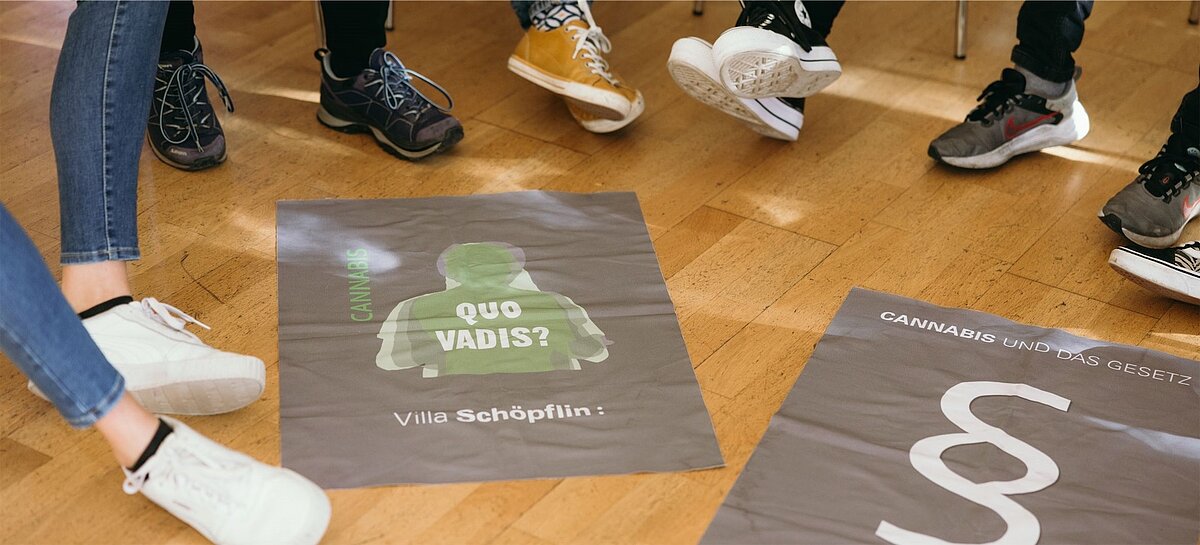
"Cannabis - quo vadis?
A class workshop on cannabis prevention for grades 8 and above
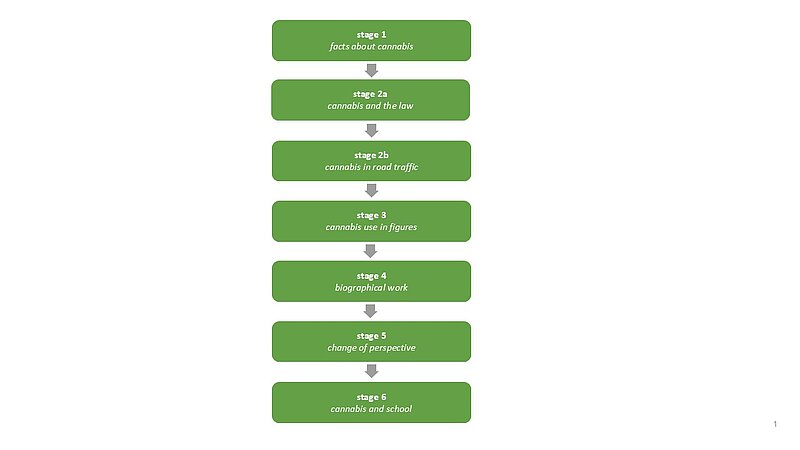
“Cannabis – quo vadis?” is an interactive workshop on cannabis prevention that provides participants with expert, factual information on the subject of cannabis in six stages.
Development & Evaluation
“Cannabis – quo vadis?” was developed in 2003 by Villa Schöpflin gGmbH in a tri-national working group (France, Switzerland, Germany). “Cannabis – quo vadis?” is a tool for promoting risk competence that has proven itself in practice throughout Germany for several years. The interactive workshop was evaluated for the first time in 2006.
With the involvement of the moderator network, Villa Schöpflin updated and expanded the workshop in 2019. For this purpose, the Federal Ministry of Health (BMG) provided financial resources to the Federal Center for Health Education (BZgA, from 2025 BIÖG). In addition, the Institute for Therapy and Health Research (IFT-Nord) conducted a current evaluation in collaboration with Villa Schöpflin. A brief summary of the results (2023) can be found here. An article on this evaluation was published in 2024 in the journal “Fortschritte der Neurologie Psychiatrie” (Advances in Neurology and Psychiatry) by Thieme Verlag. Read the article here.
Objectives & target groups
The workshop is suitable for school classes (recommended for grades 8 to 10) or youth groups (e.g., youth centers, open youth welfare services) with a group size of 10 to 35 people and can be conducted using the accompanying method box.
The objectives of the workshop are:
- Young people are educated about the diverse effects of cannabis use.
- Consistent and credible information and prevention messages are conveyed.
- Transparency and clarity are created regarding legal issues related to cannabis.
- Non-users are strengthened in their stance.
- To motivate users to reflect on their consumption.
- To encourage constructive and critical discussion among young people.
- To provide information about personal contacts at schools and support services offered by counseling centers in the region.
- Scientifically sound and consistent prevention messages encourage young people to engage in critical discussion and can influence changes in attitudes and behavior.
Structure
Implementation
A “Cannabis – quo vadis?” method box is required to implement the interactive workshop. It contains all the materials needed to conduct the workshop. The method box can only be ordered after participating in a “Cannabis – quo vadis?” training course.
Thanks to funding from the Federal Institute for Public Health (BIÖG) on behalf of the Federal Ministry of Health (BMG), the method box can be purchased free of charge in 2024 and 2025.
At least 135 minutes or at least three school hours are required to conduct the interactive workshop. The preparation time is approximately five to ten minutes.


Training courses
Are you a teacher or school social worker and would like to receive training on how to implement ‘Cannabis – quo vadis’?
Please contact the relevant trainers in your region and enquire about the next training date.
You can find the right contact person using the interactive map or the list of all trained ‘Cannabis – quo vadis?’ trainers in Germany.

Are you a prevention specialist interested in establishing ‘Cannabis – quo vadis?’ in your region?
As a ‘Cannabis – quo vadis?’ trainer, you will have the opportunity to implement the programme and train teachers, school social workers and prevention specialists to become facilitators. They will then be able to run the workshop independently.
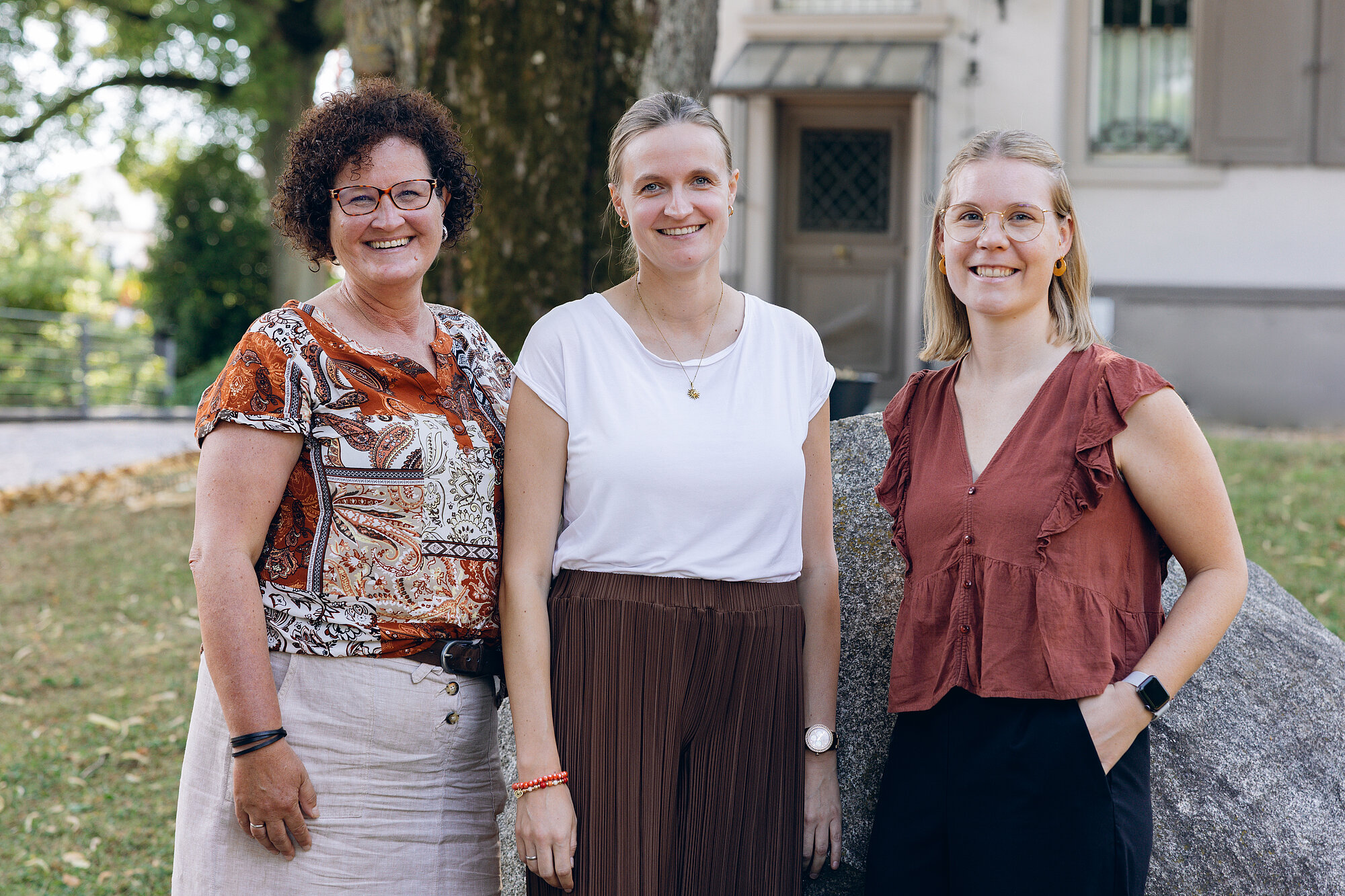
The two-day ‘Cannabis – quo vadis?’ trainer courses are run by Lena Wehrle and Franziska Ruch (prevention specialists at Villa Schöpflin gGmbH) and funded by the Federal Institute for Public Health (BIÖG) on behalf of the Federal Ministry of Health (BMG).
You can register for the respective training courses in the Events section of this website.


Project team
Contact
Franziska Ruch
Phone: 07621-914909-001
E-Mail: franziska.ruch(at)villa-schoepflin.de